
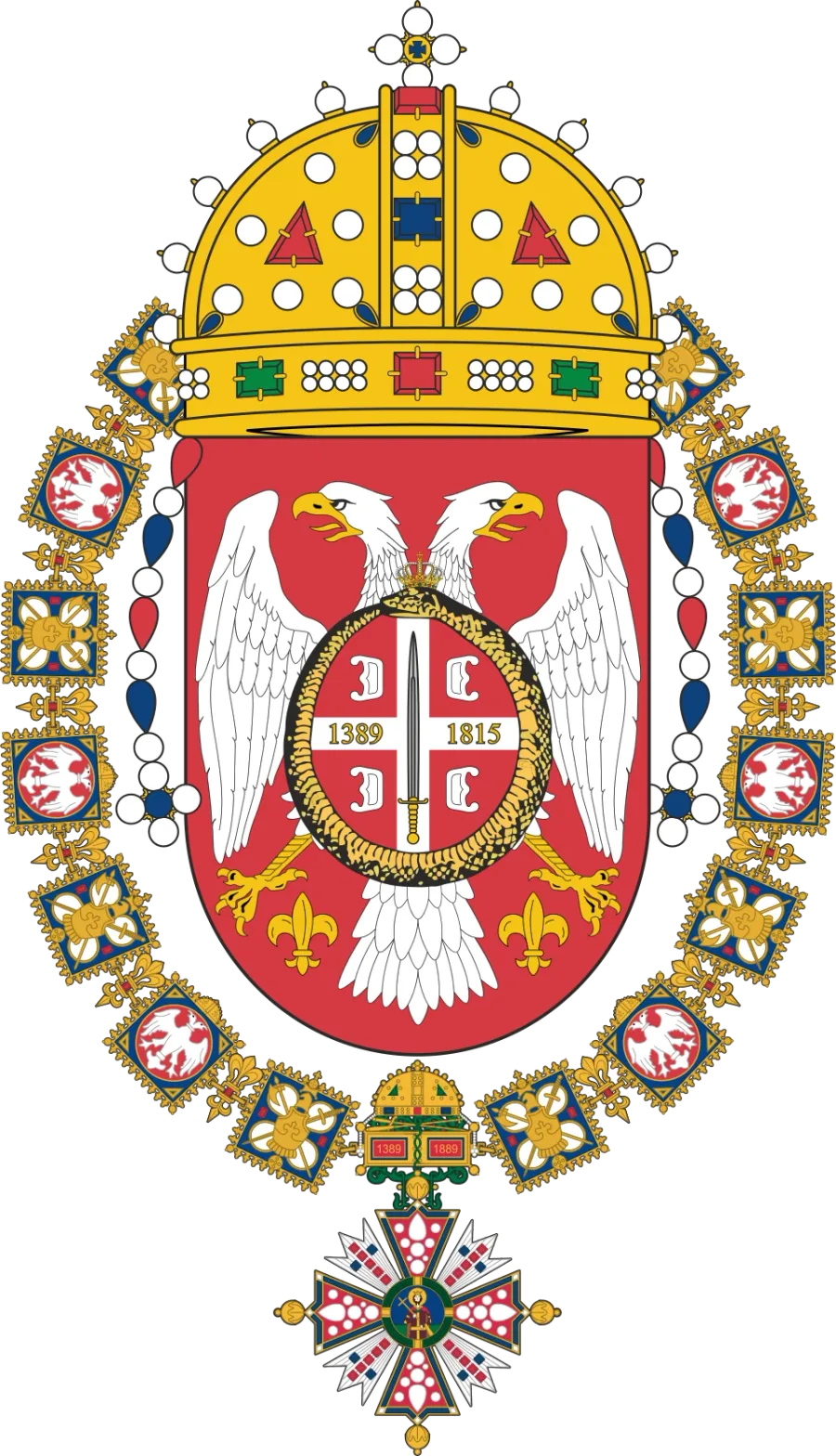
Court arms — Obrenović
Court arms
Family Heraldry

Obrenović

Serbian princely and royal dynasty

Bearer
Obrenović dynasty
Founder
Prince Miloš Obrenović
Titles
Prince, king
Period
1815–1842 and 1858–1903.

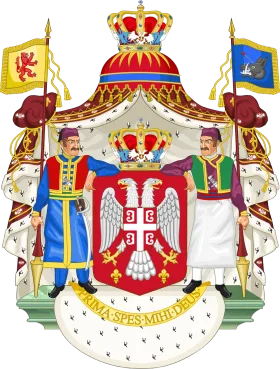
The Obrenović dynasty ruled Serbia from the Second Serbian Uprising of 1815 until 1842 and again from 1858 to 1903. Under Prince Miloš Serbia gained autonomy, under Milan Obrenović independence in 1878, and in 1882 it was proclaimed a kingdom. The years 1389 and 1815 inscribed in the escutcheon are a departure from the rules of heraldry, which do not permit inscriptions in the shield.

Blazon

Shield

On a red field a silver double-headed eagle with gold beaks and legs, accompanied in base by two gold lilies; on the eagle's breast a small round red shield with a silver cross between four silver firesteels, over which are an upright sword and the years 1389 and 1815; the small shield is encircled by a gold serpent biting its tail, and surmounted by a small crown.

Crown

Above the shield a gold crown in the form of a dome, adorned with pearls and precious stones, with a cross on top.

Order

The shield is surrounded by the collar of an order with alternating links bearing an eagle and a cross, and at the foot hangs the cross of the order.

Greater court arms

Beneath the great royal crown a blue mantle lined with ermine; the shield, surmounted by the royal crown, is supported by two angels; beneath the shield the collar of an order with its cross.

Motto of the royal house

ВРЕМЕ И МОЈЕ ПРАВО (“Time and my right”; Latin TEMPUS ET MEUM JUS).

Standard

A field in the Serbian tricolour edged with a bordure of triangles in the same colours; in the centre the court arms beneath the Obrenović crown, surrounded by the collar of an order.

Symbolism and meaning

The years 1389 and 1815 link the Battle of Kosovo and the Takovo Uprising, presenting the dynasty as the restorer of Serbian statehood after centuries of bondage. The sword on the small shield is a sign of liberation by arms, and the serpent biting its tail of eternity and continuity.
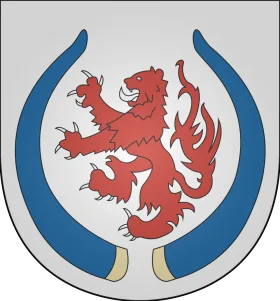
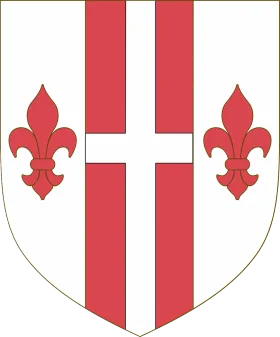
Heraldry of the house through history

  1. 1815–1819Prince Miloš

    The leader of the Second Serbian Uprising and first prince of restored Serbia used a seal before the state received arms. On Miloš's seal of 1819 a shield with a cross and four firesteels lies beneath a mantle, and above it, instead of a crown, stands a kalpak with a plume — the mark of a prince ruling within the Ottoman Empire. The prince's seal with the inscription “Милош Обреновић, први књаз српски” already bears the shield with cross and firesteels beneath a mantle and prince's crown, within a wreath. With the hatt-i sharifs of 1830 and 1833 Serbia gains autonomy, and the princely insignia their place.

  2. 1835Gospodar Jovan

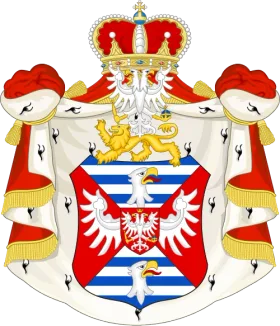
    Miloš's brother, Gospodar Jovan Obrenović, displayed arms on the front of his residence in Čačak, built in 1835: a blue shield with a silver cross and four firesteels, beneath a crown, is supported by two gold lions, and above is a crescent with a star. It is a rare surviving record of the heraldry of members of the House outside the ruling line.

  3. 1815–1882Princely house

    The arms of the Princely House of Obrenović, from the time when Serbia was a principality: beneath a prince's crown and a red mantle lined with ermine a red shield with a white cross and four firesteels, over which is an upright sword between the years 1389 and 1815, within a wreath; beneath the shield a ribbon with the motto. The years of the Battle of Kosovo and the Takovo Uprising were to become the lasting mark of the dynasty.

  4. 1839–1868Prince Mihailo

    Prince Mihailo, who ruled in 1839–1842 and 1860–1868, bore personal arms derived from those of the state: on a red shield beneath a prince's crown a white cross with four firesteels, and the supporters are a gold lion with a sabre and a green serpent; beneath the shield hang decorations. The alliance arms of Prince Mihailo and Princess Julia Hunyady are preserved on the fireplace in the main hall of the mansion at Ivanka pri Dunaji, in present-day Slovakia — a combination of the Serbian arms with the arms of the Hungarian noble family Hunyady de Kéthely.

  5. 1868–1882Prince Milan IV

    The arms of Prince Milan Obrenović IV, who in 1882 was to be proclaimed King Milan I, record the mature princely heraldry: beneath a mantle and crown the shield with cross and firesteels, sword and the years 1389 and 1815, encircled by a green serpent biting its tail, and on the ribbon the motto TEMPUS ET MEUM JUS — “Time and my right”.

  6. 1882King Milan I

    With the proclamation of the kingdom in 1882 the House begins to use the lesser arms of the Royal House: on a red shield beneath the royal crown a white double-headed eagle, on whose breast is an oval escutcheon with a sword between the years 1389 and 1815, encircled by a gold serpent biting its tail. King Milan I was also a knight of the Swedish Order of the Seraphim, so his arms were also painted according to the rules of that order — a gold double-headed eagle on a red shield beneath the royal crown, surrounded by the collar of the Order of the Seraphim.

  7. 1889–1903King Alexander

    The royal standard of Alexander Obrenović, the last ruler of the House, bore the greater arms beneath a mantle on a field in the Serbian tricolour, edged with a bordure of triangles. With the murder of King Alexander and Queen Draga in the May Coup of 1903 the dynasty became extinct.