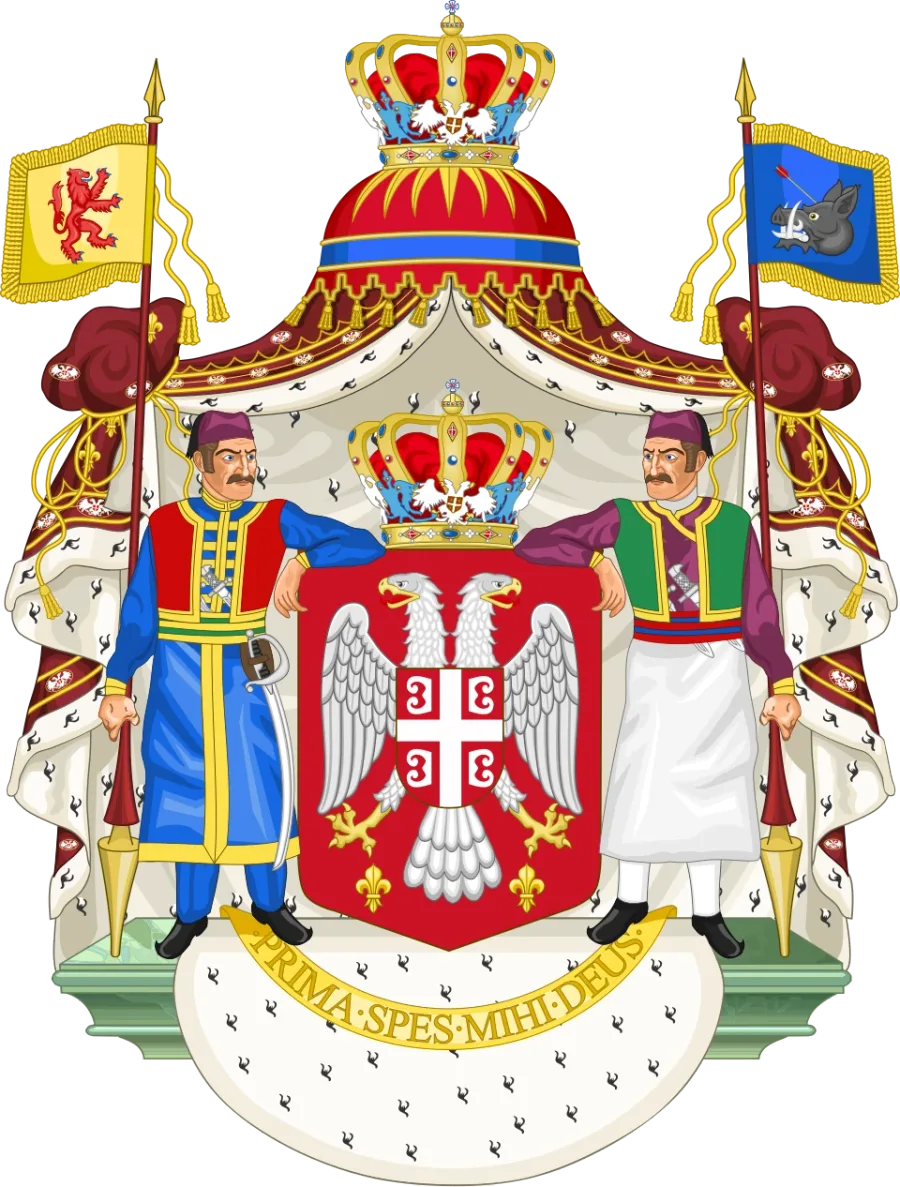
The dynasty was founded by the leader of the First Serbian Uprising, Đorđe Petrović Karađorđe. Prince Alexander Karađorđević ruled Serbia in 1842–1858, King Peter I from 1903, and from 1918 the Karađorđevićes were the rulers of the Kingdom of Serbs, Croats and Slovenes, later Yugoslavia, until the abolition of the monarchy in 1945. The greater arms of the House show the Serbian double-headed eagle, and as supporters insurgents in folk costume.
Blazon
Shield
On a red field a silver double-headed eagle, with gold beaks, tongues and legs, accompanied in base by two gold lilies; on the eagle's breast a small red shield with a silver cross between four silver firesteels.
Crown
Above the shield, a royal crown with a red cap.
Supporters
Two Serbian insurgents in folk costume, with fezzes: the dexter in a blue dolman with a sabre at his belt, the sinister in a green waistcoat and white fustanella. Each holds a lance with a standard — the dexter gold with a red lion leaping, the sinister blue with a boar's head pierced by an arrow.
Mantling
A red mantle lined with ermine, beneath a pavilion surmounted by a crown.
Motto
On a golden ribbon: PRIMA SPES MIHI DEUS.
Greater pavilion arms
The shield as in the greater arms, both heads of the eagle crowned with the heraldic crown of Serbia; the shield crowned with the crown of King Peter I with a blue fleur-de-lis in the centre. The supporters are two voivodes in the voivodes' robes of the nineteenth century, in natural colours and under arms, with banners in the Serbian tricolour edged with gold; they stand on a green compartment with medieval floral motifs, from which falls a sky-blue ribbon with the motto SPES MIHI PRIMA DEUS. The whole is draped in the coronation mantle of King Peter I, tied with gold tassels, and above the pavilion is the crown of King Peter I.
Standard of the head of the house
A square field in the colours of the Serbian tricolour — red, blue and white — edged with a bordure of triangles in the same colours; in the centre the arms of the House beneath the royal crown, surrounded by the collar of an order.
Symbolism and meaning
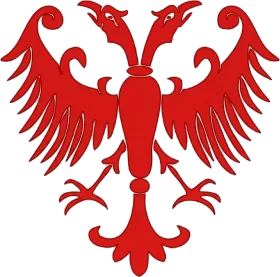
The insurgents as supporters of the shield recall the origin of the dynasty in the First Serbian Uprising, and the double-headed eagle with the cross and firesteels expresses continuity with the medieval Serbian state. The boar's head pierced by an arrow on the sinister standard is the old heraldic device of Triballia, by which Serbia was denoted in the armorials of the early modern period.
Heraldry of the house through history
1804–1813Karađorđe, the Leader
Before any arms of the dynasty stands the Leader's seal from the First Serbian Uprising. The oval shield with the Leader's monogram is surmounted by a crown and a knight's helm, from which issues an arm with a drawn sabre, and around the shield are trophies — standards, lances, rifles, cannon, a drum and cannonballs. The colours of the reconstruction are taken from the insurgents' flags: these are the insignia of a military commander and leader of the people, not of a ruler by birth.
1842–1858Princely house
Under Prince Alexander, the Leader's son, the House receives arms of princely dignity. Preserved on the death notice of Prince Andrija, the prince's son, they show a shield with a cross and four firesteels beneath a prince's crown, supported by two insurgents in costume with fezzes, with standards in the Serbian colours bearing a boar's head; all beneath a red mantle lined with ermine. Insurgents as supporters of the shield have remained a mark of the dynasty to this day — a reminder that the House sprang from the uprising.
before 1903Prince Petar in exile
Before ascending the throne Prince Peter Karađorđević bore on his personal seal a shield with a cross and four firesteels, on whose horizontal limb was inscribed the year 1804 — the year of the uprising by which his grandfather raised the dynasty — beneath a prince's crown. A year in the shield is a departure from the rules of heraldry, but it clearly expresses a programme: the return of the House is tied to the heritage of the struggle for freedom.
1919–1922Kingdom of Serbs, Croats and Slovenes
With the unification of 1918 the Karađorđevićes become the ruling house of the new state. The first arms of the Kingdom of SCS, in use from 1919 to 1922, retain the Serbian double-headed eagle beneath the royal crown and mantle, and in the shield on the eagle's breast add to the Serbian cross with firesteels the Croatian chequy and the insignia of Slovenia.
1918–1941Arms of the House of Yugoslavia
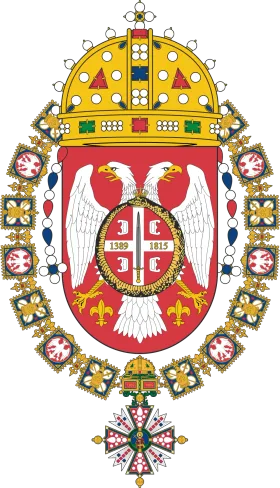
The court arms of the Yugoslav period gather the insignia of the peoples of the united kingdom in a single oval shield: the Serbian cross with firesteels, the Croatian chequy and the blue Carniolan eagle as the insignia of Slovenia, beneath the royal crown and surrounded by the collar of an order.
1937–1941Standard of the King of Yugoslavia
The royal standard of 1937: on a red square field a white double-headed eagle beneath the royal crown, with a shield containing the Serbian, Croatian and Slovene arms, and the field is edged with a bordure of triangles in blue, white and red. The standard was flown wherever the king was in residence — at court, on a ship or on a vehicle.
contemporaryCourt arms and the standard of the head of the house
The modern heraldry of the Royal House was arranged by the heraldic artist of the House, Ljubodrag Grujić. The greater pavilion arms have the shield crowned with the crown of King Peter I with a blue fleur-de-lis in the centre, and the supporters are two voivodes in nineteenth-century robes, with banners in the Serbian tricolour; the whole is draped in the coronation mantle of King Peter I, and on the ribbon is the motto Spes mihi prima Deus. The standard of the Head of the House, derived from the standard of the King of Serbia of 1917, has a field in the Serbian tricolour edged with a bordure of triangles in the same colours, and in the centre the Serbian arms beneath the crown, surrounded by the collar of an order; with the lesser court arms it completes that system.
contemporaryCoats of arms of the members of the Royal House
The Rules of the Royal House prescribe a system of differences: the king, as Head of the House, bears the full arms, and sons and daughters, according to order of birth, the arms with the appropriate heraldic differences, so that the bearer's place in the family can be read from each coat of arms.
20th centuryPrinces Tomislav and Andrej
The sons of King Alexander I, Princes Tomislav (1928–2000) and Andrej (1929–1990), bore identical personal arms: a shield with the Serbian and Croatian insignia, beneath a crown, supported by two falcons on a grassy base.
20th–21st centuryPrince Pavle and the princely branch
The junior line of the House, from Prince Arsen, brother of King Peter I, bears the title of Princes of Serbia and Yugoslavia, without the right of succession to the throne. Its personal arms have a red shield with a white double-headed eagle, on whose breast is a red shield with a white cross and four firesteels, and around the shield a gold bordure — the mark of the junior branch. The Serbian royal crown is found only on the arms of Prince Paul, regent in 1934–1941, and of his children, Prince Alexander (1924–2016) and Princess Elizabeth; the descendants of Prince Alexander bear a gold royal heraldic crown. The arms of Prince Paul still bear the Croatian insignia on the eagle's breast as well, and in 2006 Prince Alexander removed the Croatian and Slovene insignia from his arms and arranged insignia for his descendants. Princess Elizabeth, as a woman, bears her arms on a lozenge, with a ribbon bearing the motto “Служба је љубав на делу” (“Service is love in action”).
1973Marital coat of arms
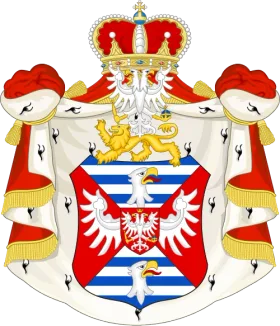
The marital (alliance) arms of Prince Alexander and Princess Barbara of Liechtenstein, who married in 1973, combine the arms of the princely branch of the Karađorđevićes with the arms of the Princely House of Liechtenstein.
21st centurySons of Prince Aleksandar
The sons of Prince Alexander bear arms with a gold royal heraldic crown and differences showing order of birth; Prince Dimitri has been head of the princely branch since his father's death in 2016.
21st centuryPrince Philip
The lesser arms of Prince Philip, son of Crown Prince Alexander, were drawn by the heraldic artist of the Royal House, Ljubodrag Grujić: on a red shield a white double-headed eagle with a shield on its breast bearing a cross with four firesteels, and at the base two fleurs-de-lis, beneath the royal crown.