
City of Belgrade
City of Beograd, Beogradski region
- Bearer
- City of Belgrade
- Adopted
- 1931 (restored in 1991)
- Authors
- Đorđe Andrejević Kun (1931); Dragomir Acović (greater arms and their master drawing); the restoration of 1991 was prepared by a working group: Dragomir Acović, Mira Kun, Branko Miljuš and Tomislav Lakušić
- Decision
- Statute of the City of Belgrade (1991); the standards of the arms were published in the “Official Gazette of the City of Belgrade”, no. 14/96, and those of the flag in no. 8/97
- Region
- Belgrade Region
- Eparchy
- Archbishopric of Belgrade and Karlovci
- Official website
- beograd.rs
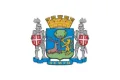
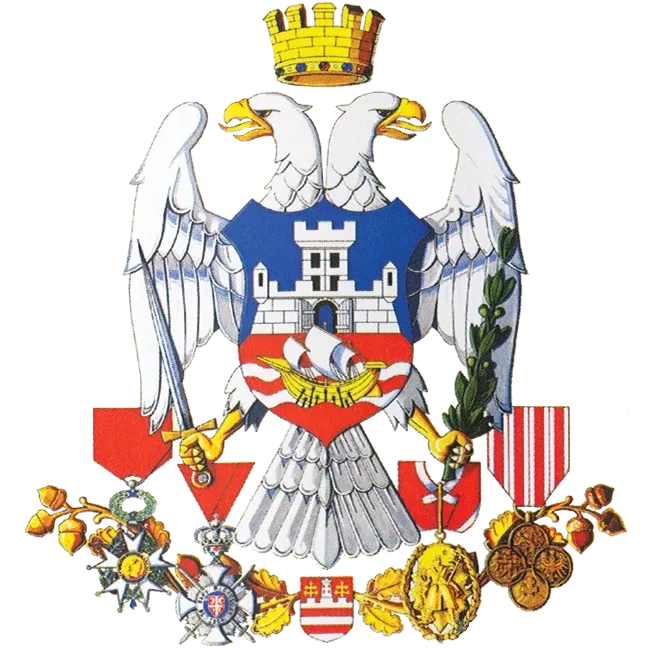
The City of Belgrade uses arms in three levels — lesser, middle and greater — and a square banner. The arms were designed in 1931 by the painter Đorđe Andrejević Kun, and after the Second World War fell into oblivion; the City Assembly restored them in 1991 as part of the Statute, with three minor corrections. The standards of the arms and flag were produced by the Serbian Heraldry Society “White Eagle”, the greater arms and their master drawing being the work of Dragomir Acović, and the banner has been in use since 1995. The middle arms consist of the shield beneath a gold mural crown with a diadem, and in the greater arms the shield is borne on the breast of a white double-headed eagle, beneath which hang four decorations awarded to the city: the Legion of Honour (21 December 1920), the Czechoslovak War Cross (8 October 1925), the Order of the Star of Karađorđe with Swords (18 May 1939) and the Order of the People's Hero (20 October 1974). The right to use the greater ceremonial arms belongs to the mayor, who with them represents the city in official communication.
Blazon
A shield ending at the base in a slight point. On a blue field a silver masonry wall with an open gate, a tall tower in the centre and a smaller tower at each end; the lower part of the shield is red, with silver wavy rivers at the flanks, and across them sails a gold Roman trireme with silver sails.
A gold mural crown with a diadem set with precious stones; in the greater arms the crown has five visible crenellations.
A silver double-headed eagle with wings displayed, crowned with a mural crown, bearing a shield on its breast and holding a sword in its right talon and an olive branch in its left.
Beneath the eagle two gold oak branches with acorns, from which hang four decorations, and between them a small shield with the old arms of Belgrade.
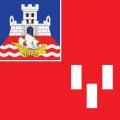
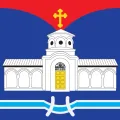
A square flag, in the proportion 1:1, repeating the content of the shield: on blue a white wall with towers and an open gate, beneath it red ground between white wavy rivers and a yellow trireme with white sails.
Symbolism and meaning
The principles for the arms were laid down by a committee in 1931. The river represents the original strength of Belgrade, and the Roman trireme its antiquity. The wall denotes a trading city, the tower the city itself, and the open gate a free market. The red ground between the rivers and beneath the wall is a symbol of the blood and centuries of suffering of Belgrade, the white of the wall and tower recalls the name “White City”, and the blue sky expresses hope and faith in a better future; the rivers are white in keeping with the rules of heraldry. The colours of the arms are at the same time the state colours. On the mural crown of the greater arms the five crenellations denote a great city in the region, and the diadem a capital.