
City Municipality of Palilula
City of Beograd, Beogradski region
- Bearer
- City Municipality of Palilula
- Adopted
- 7 June 2006
- Decision
- Decision on the use of the symbols of the City Municipality of Palilula, 7 June 2006.
- Grad
- City of Belgrade
- Region
- Belgrade Region
- Eparchy
- Archbishopric of Belgrade and Karlovci
- Official website
- palilula.eu
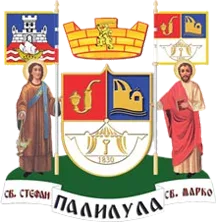
The City Municipality of Palilula uses arms in three levels — basic (lesser), middle and greater — and a square banner. At its twelfth session, on 7 June 2006, the Assembly of the City Municipality adopted the decision laying down the appearance and use of the arms and flag. The shield bears a canting device — the pipe from which the place took its name — then the dome of the Church of Saint Mark and a stylised tent with a key and the year 1830; the greater arms have Saint Stephen and Saint Mark as supporters.
Blazon
A shield divided horizontally, and the upper half vertically as well, with the fields edged in gold: in the first, red field a gold pipe; in the second, blue, the stylised dome of the Church of Saint Mark above two winding gold lines; in the lower, silver field a gold stylised tent, a gold key and the year “1830”.
A gold mural crown with three visible crenellations; in the greater arms a gold lion stands on it holding a gold sword in its right paw.
On the (heraldic) dexter the Holy Protomartyr and Archdeacon Stephen in a deacon's vestments, with the banner of Belgrade; on the sinister the Holy Apostle and Evangelist Mark in a red cloak, with a book and the banner of Palilula.
A green hillock.
A white ribbon with the inscription “ПАЛИЛУЛА” in the centre and “СВ. СТЕФАН” and “СВ. МАРКО” at the ends.
The square banner repeats the field of the basic arms: above, a gold pipe on red and the dome of the Church of Saint Mark on blue; below, on silver, a gold tent with a key and the year “1830”.
Symbolism and meaning
The pipe is a canting device: in Ottoman times smoking was forbidden within the walls of Belgrade, so smokers went outside the ramparts, to a place now called Palilula (from “paliti”, to light, and “lula”, pipe). The church on the blue field is the Church of Saint Mark, one of Belgrade's landmarks. The year 1830 recalls the moment when Prince Miloš Obrenović received the Sultan's hatt-i sharif, by which Serbia gained the status of a principality with a measure of autonomy; this took place at Tašmajdan, in the area of Palilula.