
City Municipality of Mladenovac
City of Beograd, Beogradski region
- Bearer
- City Municipality of Mladenovac
- Adopted
- 15 May 2002
- Authors
- Father Aleksej von Biron (concept), Dragomir Acović (drawing)
- Decision
- Decision on the coat of arms and banner of the municipality and settlement of Mladenovac
- Grad
- City of Belgrade
- Region
- Belgrade Region
- Eparchy
- Archbishopric of Belgrade and Karlovci
- Official website
- mladenovac.rs
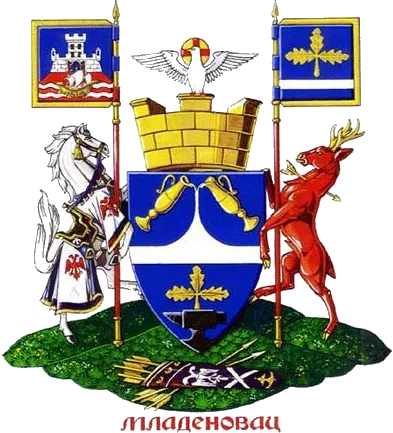
The City Municipality of Mladenovac uses arms in three levels — greater, middle and lesser — and a square banner, produced to the standards of the Serbian Heraldry Society. All the insignia were adopted on 15 May 2002 by the Decision on the Coat of Arms and Banner of the Municipality and Settlement of Mladenovac, to a concept by Father Aleksej von Biron, and were given graphic form by Dragomir Acović, president of the Serbian Society for Heraldry, Genealogy, Vexillology and Phaleristics. The arms are rich in meanings: from the mineral springs and the Lug stream to the tradition of the death of Despot Stefan Lazarević on Kosmaj.
Blazon
A blue shield divided by a silver bar: in the upper part two gold ewers tilted towards each other, from which silver streams of water flow, joining and pouring into the bar in the form of an inward-curving wedge; in the lower part, from the foot of the shield, a black anvil from which grows a cross-shaped gold oak shoot with three leaves.
In the middle and greater arms a gold mural crown with three visible merlons; in the greater arms a white dove stands on it with wings displayed, with a gold beak and red legs, and a gold halo containing a red cross.
On the dexter a white horse rampant with black hooves, bridled and saddled as the horse of a despot — the headstall, reins and girths are purple, the saddle cloth purple, and the white caparison embroidered with crimson double-headed eagles and edged with purple; on the sinister a red roebuck rampant with gold antlers, tongue and hooves, pierced through the neck by a gold arrow. Between the supporters and the shield, red lances shod with gold rest on the ground, from which fly banners fringed with gold — on the dexter the banner of the City of Belgrade, on the sinister the banner of Mladenovac.
The forested slopes of Kosmaj; at the foot, beneath the shield, a purple despot's quiver has fallen, open to the right, adorned with silver and gold and a silver double-headed eagle, with three gold arrows, and beneath it two more crossed gold arrows lie on the ground.
Beneath the arms a white ribbon with the crimson Cyrillic inscription “МЛАДЕНОВАЦ”; in the middle arms the ribbon stands beneath the shield.
A square blue banner with a lowered white bar near the bottom and a gold cross-shaped oak shoot of three leaves in the upper field.
Symbolism and meaning
The two gold ewers denote the two spas with mineral water, and the silver bar the Lug stream. The name Mladenovac is linked to the root “mlad” (young), and a “mladica” is a budding shoot — hence the oak sprig with three leaves. The oak is also a sign of the Holy Trinity, the town's patronal feast, also called Pentecost, and so a white dove rests on the mural crown. The town is young (founded in 1883) and grew quickly alongside heavy industry, which is why the sprig grows from an anvil.
The supporters, the compartment and the scattered arrows recall Despot Stefan Lazarević, ruler of Serbia, who met his death in the forests of Kosmaj in the early fifteenth century after a hunting accident. The supporters bear the flag of the City of Belgrade (dexter) and the banner of Mladenovac (sinister).