
Municipality of Lapovo
Šumadija District, Region of Šumadija and Western Serbia
- Bearer
- Municipality of Lapovo
- Adopted
- March 2000
- Author
- Dragomir Acović
- District
- Šumadija District
- Region
- Region of Šumadija and Western Serbia
- Eparchy
- Eparchy of Šumadija
- Official website
- lapovo.rs
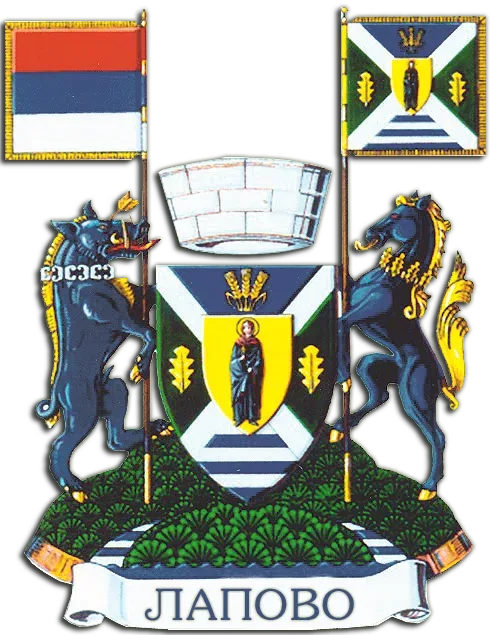
The Municipality of Lapovo uses arms in three levels — lesser, middle and greater — and a banner with the composition of the shield. The arms were adopted in March 2000, and the author is Dragomir Acović. At the centre of the arms is Saint Petka (Paraskeva), patron saint of Lapovo, and the saltire recalls the importance of the place as a junction of roads and railways. A white flag with the greater arms in the centre is also in use.
Blazon
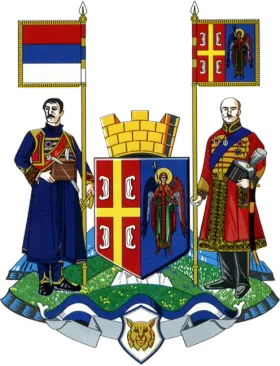
A shield divided by a silver saltire: in the upper blue field three gold ears of wheat, in the side green fields a gold oak leaf each, and in the lower blue field three silver bands; over all, in the centre, a small gold shield with Saint Petka in natural colours.
In the middle and greater arms, a silver mural crown without merlons.
In the greater arms, on the dexter a wild boar with gold tusks and a red tongue, wounded diagonally in the forehead by a gold arrow, with a collar of silver firesteels, holding the flag of Serbia; on the sinister a blue horse with a gold mane, tail and tongue, with a collar of gold oak leaves, holding the banner of Lapovo. In the middle arms, instead of supporters, the shield is surrounded by gold oak branches with acorns.
A hillock overgrown with forest.
A silver ribbon with the inscription “ЛАПОВО”, beneath the shield in the middle arms and beneath the compartment in the greater.
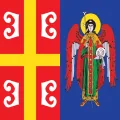
A square flag with the composition of the shield: a white saltire, above on blue three gold ears of wheat, at the sides on green gold oak leaves, below blue and white stripes, and in the centre a small gold shield with Saint Petka.
Symbolism and meaning
Saint Petka (Paraskeva) is the patron saint of Lapovo. The saltire indicates that Lapovo is one of the most important crossroads and railway junctions in Serbia. The ears of wheat represent agriculture, the oak leaves forests, and the blue and white stripes the River Morava. The wounded boar is the old apocryphal arms of Serbia, later attributed to Šumadija, in which Lapovo lies. The blue colour of the supporting horse also alludes to the Morava, since the old word “morav” means “dark blue”.