
City of Bijeljina
Bijeljina, Republika Srpska Region
- Bearer
- City of Bijeljina
- Adopted
- 2 February 1994
- Levels of the arms
- greater, middle and lesser
- Region
- Bijeljina Region
- Entity
- Republika Srpska
- Official website
- gradbijeljina.org
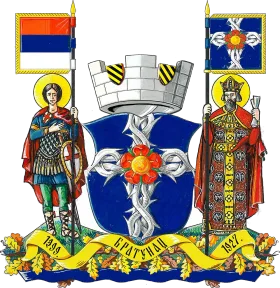
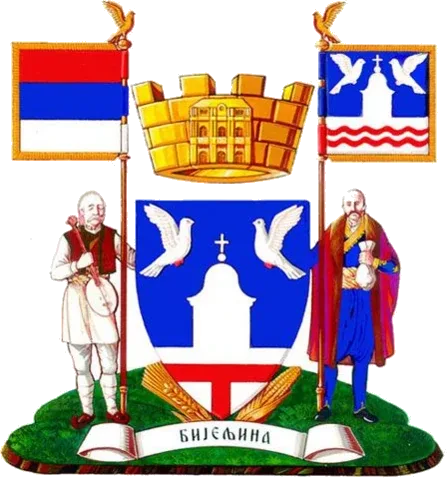
The arms of Bijeljina were adopted on 2 February 1994, in three levels — greater, middle and lesser. They rest on the tradition of European heraldry and on the enduring symbols of Semberija.
Blazon
On a blue, slightly pointed shield, between two silver doves facing each other with red legs and wings raised and drawn together, the silver silhouette of the dome, surmounted by a cross, above the drum of the Tavna Monastery, rising from a silver base; in the base a raised red bar resting on a like pale.
A gold mural crown with four visible merlons, the mark of a city with more than a hundred thousand inhabitants; in the centre of the crown the gold central projection of the main façade of the City Assembly.
On the dexter Filip Višnjić in folk dress, with a gusle on his breast, on the sinister Prince Ivo of Semberija with a bag of money, in natural colours; beside them lances with the flags of Republika Srpska and Bijeljina, fringed with gold, with a gold dove on top.
A grass-covered plain; beside the shield a gold ear of wheat and a gold maize cob; at the base a white ribbon with the inscription “БИЈЕЉИНА”.
A blue banner with the content of the shield: two silver doves about a white dome with a cross, and at the base red and white wavy bars.
Symbolism and meaning
The Tavna Monastery is the oldest holy place of the area, the doves a sign of peace, and the supporters — the gusle player Filip Višnjić and Prince Ivo of Semberija, who ransomed slaves — the two best-known figures of Semberija's history. The ears of wheat and the maize speak of the fertile plain.