
City of Banja Luka
Banja Luka, Republika Srpska Region
- Bearer
- City of Banja Luka
- Adopted
- 20 July 2017
- Authors
- Dragomir Acović and Ljubodrag Grujić
- Levels of the arms
- basic, middle and greater
- Region
- Banja Luka Region
- Entity
- Republika Srpska
- Official website
- banjaluka.rs.ba
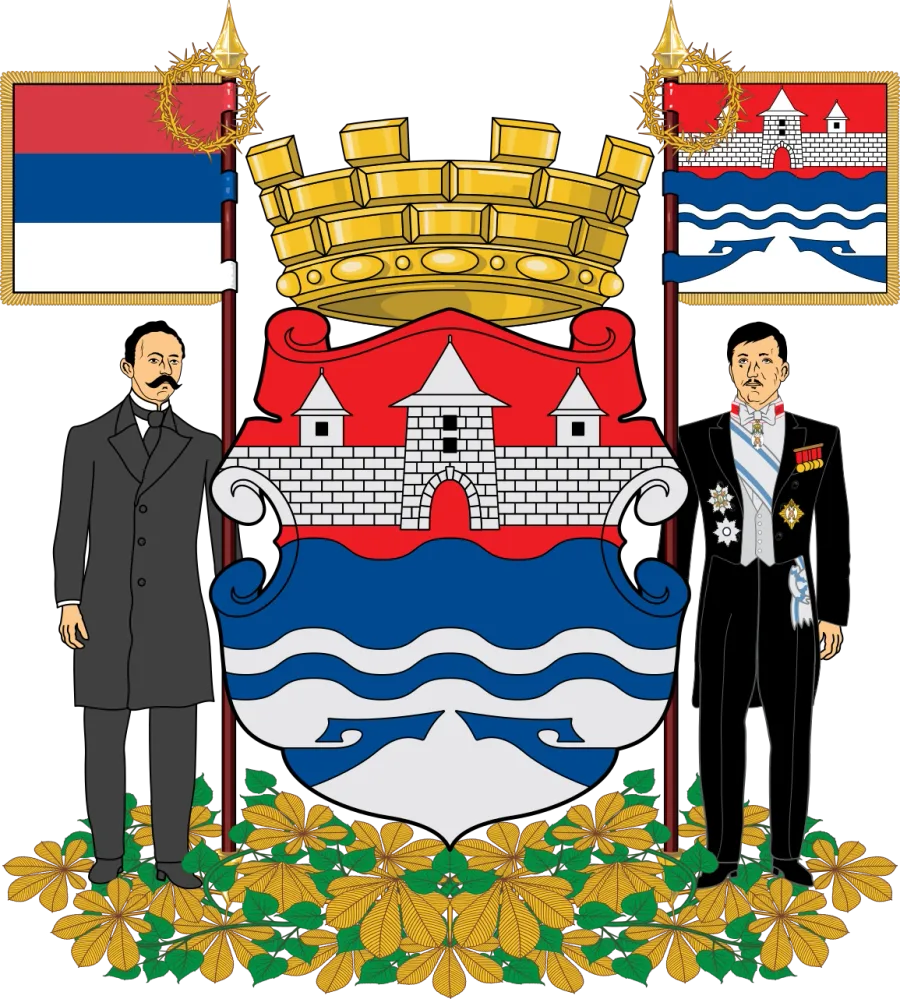
The arms of the City of Banja Luka in three levels — basic, middle and greater — were produced by the heraldists Dragomir Acović and Ljubodrag Grujić, and the City Assembly adopted them on 20 July 2017. With this Banja Luka, after four years without official insignia, received arms in keeping with the rules of heraldry. The previous arms, in use since 1992, were declared unconstitutional by the Constitutional Court of Republika Srpska in 2013.
Blazon
Divided horizontally: above, on red, a silver stone wall masoned with black joints, in the centre with a two-storey tower with an arched open gate, a black window on each storey and a pyramidal silver roof with pronounced eaves, and on each side a smaller single-storey tower with a window and a like roof; below, on silver, the blue facing prows of two boats — dajaks — issuing from the flanks of the shield; over all a wavy blue bar above a like narrow bar.
Middle arms: the shield crowned with a gold stone-built mural crown with four visible merlons and a diadem.
Greater arms: on the dexter Petar Kočić in a dark grey frock coat of the early twentieth century, on the sinister Ban Svetislav Milosavljević in a tailcoat with decorations and a sash, in natural colours. Both hold a wooden staff shod with gold with a square banner — on the dexter that of Republika Srpska, on the sinister that of Banja Luka — fringed with gold; the lances are wreathed with a gold crown of thorns.
A bunch of gold horse chestnut leaves intertwined with green leafy lime sprigs.
A square banner with the same content as the shield of the basic arms.
Symbolism and meaning
The wall with towers represents the Kastel fortress, the core of the city, and the wavy bar the River Vrbas. The dajaks — traditional Vrbas boats — tie the city to the river and its customs. The supporters are two figures from Banja Luka's history: the writer and people's tribune Petar Kočić and Ban Svetislav Milosavljević, builder of modern Banja Luka in the time of the Vrbas Banovina. The chestnut leaves recall Banja Luka's avenues.