
City of Vranje
Pčinja District, Region of Southern and Eastern Serbia
- Bearer
- City of Vranje
- Seat
- Vranje
- Adopted
- 27 November 2013
- First mention
- 1093
- Authors
- N. T. Štiplija, N. Salatić, D. Stanojković
- District
- Pčinja District
- Region
- Region of Southern and Eastern Serbia
- Eparchy
- Eparchy of Vranje
- Official website
- vranje.rs
Blazon
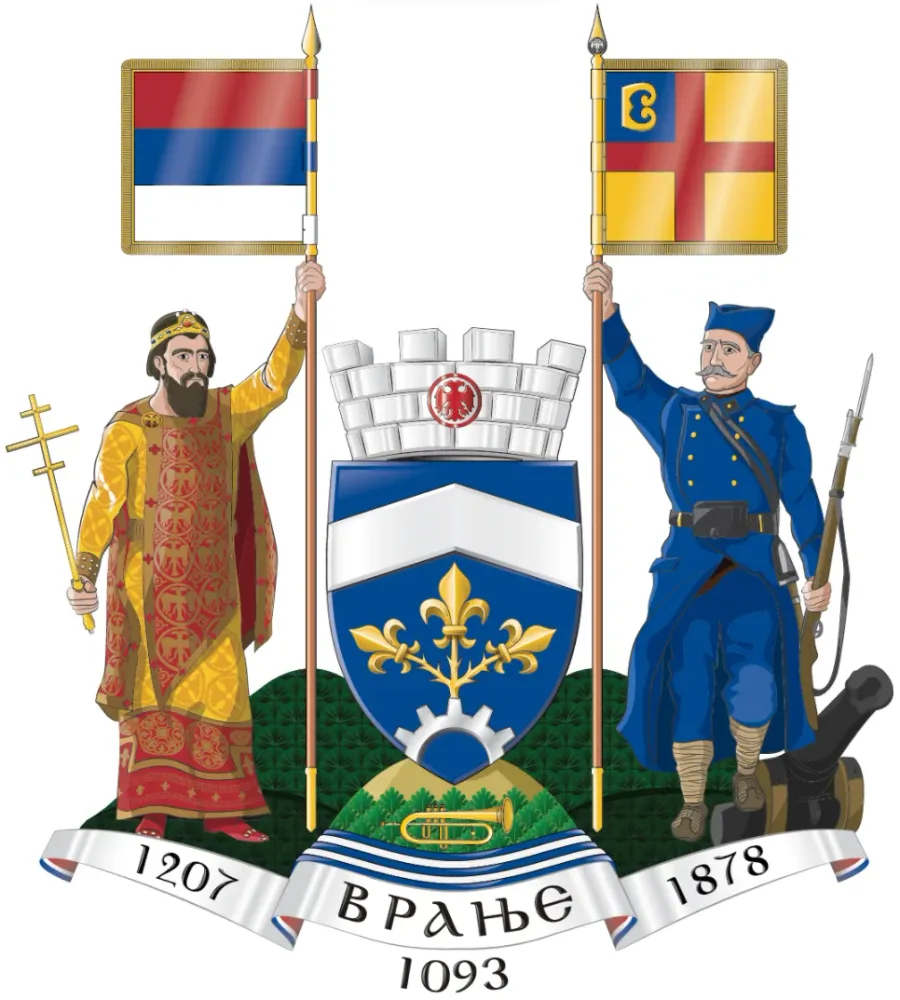
A blue shield with a silver, slightly broken bar in the chief. The blue colour (sea blue/the colour of the Morava) alludes to the South Morava and the Pomoravlje, while the silver bar heraldically represents the White Bridge.
Above the shield is a silver mural crown with four visible merlons. On the central part of the crown is a red “kolasta azdija” (a double-headed eagle within a circle). The shield is surrounded by a half-wreath of vine stock and gold tobacco leaves.
The left-hand (heraldic dexter) supporter is King Stefan the First-Crowned (the figure from the fresco at Mileševa). The right-hand (heraldic sinister) supporter is a Serbian soldier from the wars of liberation of 1876–1878 (“Čika Mita”).
A hilly compartment in ochre (a symbol of Pržar Hill), half covered with conifers. In the centre is a gold trumpet as a symbol of the music of Vranje.
Square, on a yellow (gold) field with the red Cross of Takovo. In the upper left blue canton is a gold firesteel turned towards the mast.
Symbolism and meaning
Since 2013 the City of Vranje has borne heraldically correct arms in three levels. This design was chosen in a public competition and is the work of a team of authors: Nemanja Todorović Štiplija, Nikola Salatić and Dalibor Stanojković.
The symbolism of the arms is deeply rooted in the identity of the area. The blue colour of the shield symbolises justice and loftiness, but is also a direct allusion to the River South Morava. The central motif, the White Bridge, is represented by a silver bar, giving the city's best-known landmark its place on the shield.
The economic and cultural identity is shown through the wreath (vine and tobacco) and the gold trumpet on the compartment, while the historical line is upheld by King Stefan the First-Crowned and the nineteenth-century liberator of Vranje.