City of Niš
Nišava District, Region of Southern and Eastern Serbia
- Bearer
- City of Niš
- Adopted
- 1996.
- Author
- Dragomir Acović
- Decision
- Statute of the City of Niš of 6 June 2002, Article 9 (flag)
- District
- Nišava District
- Region
- Region of Southern and Eastern Serbia
- Eparchy
- Eparchy of Niš
- Official website
- ni.rs
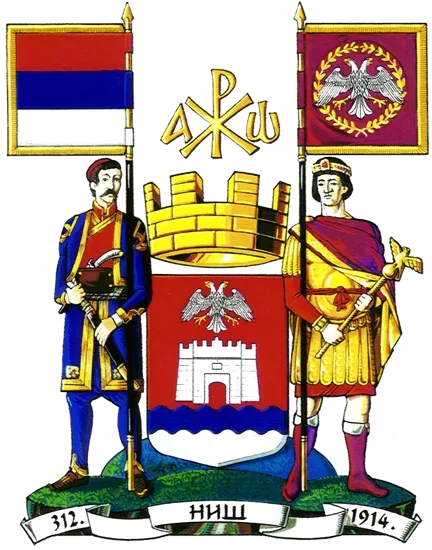
The City of Niš uses arms in three levels — lesser, middle and greater — and a flag. The arms were adopted in 1996 on the principles of the New Serbian Heraldry, with certain departures, and the author is Dragomir Acović; the appearance of the flag is prescribed by the Statute of the City of 2002. The lesser arms have not taken root in practice, so the greater arms are used even when the lesser should be, for example in the weather forecast on television. The greater arms have as supporters Voivode Stevan Sinđelić with the Serbian tricolour and Emperor Constantine the Great with the purple city banner, and the flag is blue, with the greater arms in the upper corner next to the lance. The banner recommended by the Serbian Heraldry Society was not adopted as the city flag and appears only in the greater arms.
Blazon
On a red field a silver double-headed eagle with gold beak and legs, beneath it a silver masonry fortress with crenellations and an open gate, and at the base of the shield a blue wavy bar and a silver base.
A gold mural crown; in the greater arms above it is a Chi-Rho with the letters alpha and omega.
On the dexter Stevan Sinđelić in folk costume, holding the flag of Serbia, and on the sinister Emperor Constantine the Great in Roman armour and a purple cloak, holding the purple banner of the city. On the flag of Serbia in the greater arms as used there is a gold cross with firesteels, although a version without it, corresponding to the original proposal, is also sometimes used. In the middle arms, instead of supporters, the shield is surrounded by vines with bunches of grapes.
A green grassy hill.
A white ribbon with the inscription “НИШ” in the centre and the years “312.” and “1914.” at the ends. In another version of the ribbon, besides the Cyrillic name of the city, the Greek form “Nisos” and the Latin “Naissus” are also written.
According to the Statute, a blue rectangular flag in the proportion 1:2 with the symbol of the city in the upper corner next to the lance, occupying one sixth of the area of the flag; it is flown alongside the flag of Serbia. In practice a stockier flag, in a proportion of about 2:3, is also used. A square blue flag with the greater arms is also used unofficially.
A purple square flag with a white double-headed eagle with yellow beak and legs and a red tongue, laid over a yellow laurel wreath; it was not adopted as the city flag.
Symbolism and meaning
The fortress is the symbol of the city, the wavy bar represents the River Nišava, and the double-headed eagle above the fortress denotes Serbia. The dexter supporter is Stevan Sinđelić, the Serbian voivode killed in 1809, and the sinister the Roman emperor Constantine the Great.