
City of Leskovac
Jablanica District, Region of Southern and Eastern Serbia
- Bearer
- City of Leskovac
- Adopted
- 12 March 2005
- Authors
- Marko Drašković (concept), Dragomir Acović (drawing)
- District
- Jablanica District
- Region
- Region of Southern and Eastern Serbia
- Eparchy
- Eparchy of Niš
- Official website
- gradleskovac.org
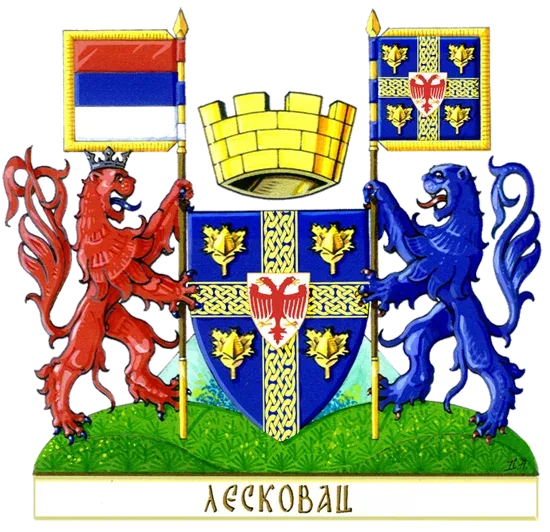
The City of Leskovac has arms in three levels — lesser, middle and greater — and a banner, a square flag that repeats the field of the shield, like most Serbian municipal flags. The arms and flag were established on 12 March 2005; the idea came from Marko Drašković, and the drawing was made by Dragomir Acović. The arms are conceived as a summary of the historical and cultural heritage of the city: the plaited cross recalls the textile tradition and Leskovac's position at a crossroads, the hazelnuts the name of the city, and the red double-headed eagle the age of the Nemanjić dynasty. In addition to the banner, a vertical flag is also flown in the city.
Blazon
On a blue field a gold cross of double-plaited rope, accompanied in each angle by a gold hazelnut; over the centre of the cross a small silver shield with a red double-headed eagle with gold beak and legs.
A golden mural crown.
In the greater arms the shield is supported by two lions rampant, the dexter red with a crown and the sinister blue; the dexter bears the flag of Serbia and the sinister the city's banner, both on lances with gold heads. In the middle arms, instead of supporters, there are green stalks with palmate leaves and flower spikes, and at the base hazel sprigs with leaves and nuts.
A green grassy hill, with a light-coloured hill behind the shield.
A silver ribbon with the red inscription “ЛЕСКОВАЦ”; in the middle arms the same inscription stands beneath the shield without a ribbon.
A square flag repeating the field of the shield: a blue field with the gold plaited cross, four gold hazelnuts and the silver shield with the red double-headed eagle in the centre.
Symbolism and meaning
Blue denotes the sky, holiness, water and peace; it was also the colour of the earlier municipal emblem, and the old Slavic word for blue, “morav”, recalls the River Morava, whose basin covers most of the south of Serbia. Gold is a sign of holiness, constancy and endurance through time.
The cross of double-plaited rope has a twofold meaning: suffering and resurrection, but also the civilisation to which Serbia belongs. The rope recalls the beginnings of the textile production from which Leskovac's crafts and industry developed, and the cross as such a crossroads — as a town and marketplace Leskovac is the centre of that crossroads, destroyed several times in wars and raised again from the ashes.
The gold hazelnuts speak the name of the city (“lešnik”, hazelnut; “leska”, hazel). The small silver shield with the red double-headed eagle recalls the time when Grand Župan Stefan Nemanja won the land of Dubočica from the Byzantine emperor Manuel I Komnenos. In Byzantium the red eagle was a device reserved for despots and the high nobility, and the Nemanjić dynasty used it until the imperial coronation of Stefan Dušan in 1346.